
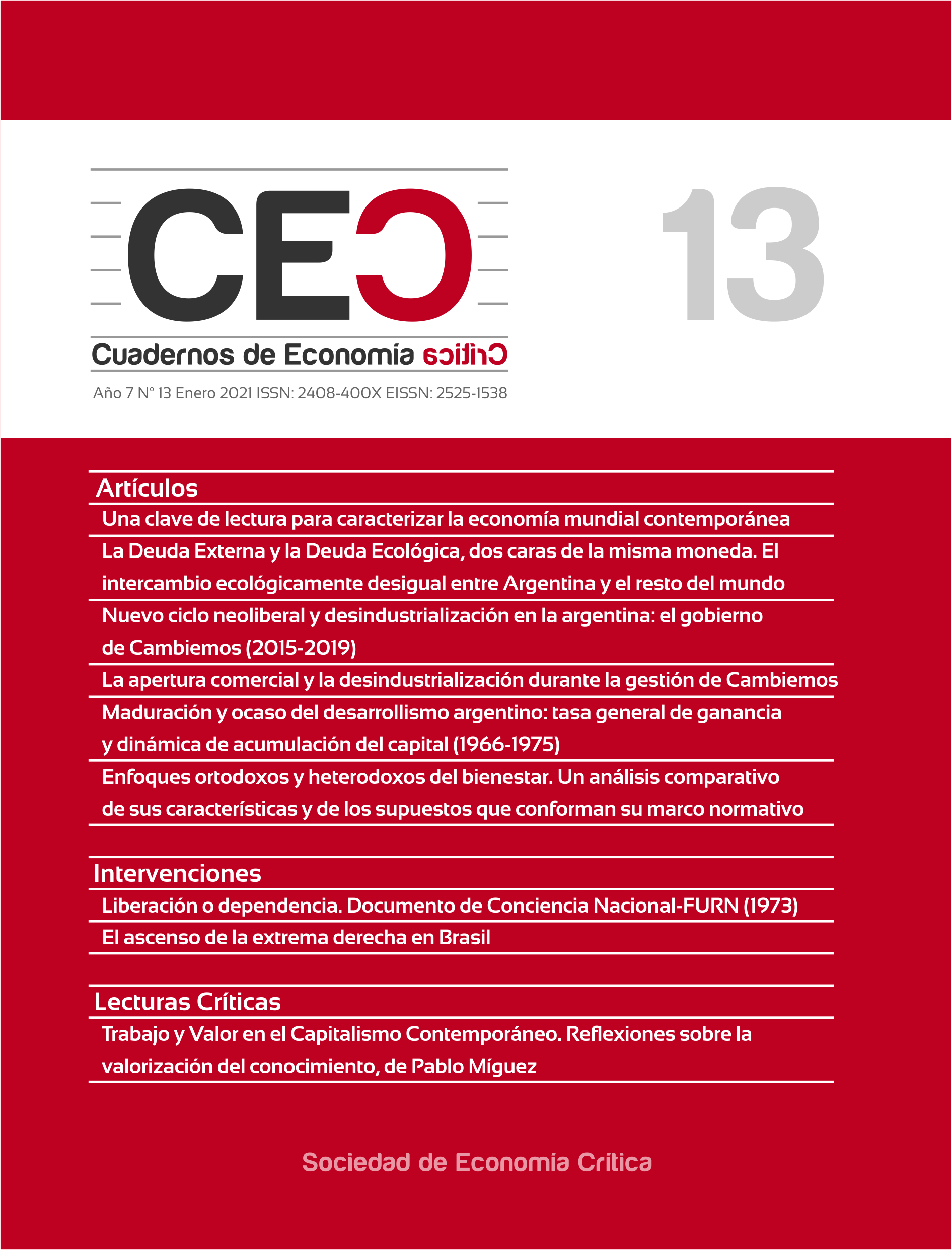
Orthodox and heterodox approaches to welfare/wellbeing.
A comparative analysis of its characteristics and the assumptions that make up its normative framework
Keywords:
capabilities, human needs, normative frameworkAbstract
In this article we intend to determine those theoretical-philosophical approaches to welfare and well-being that are compatible with the ideals of equity, justice and freedom, that is, what is understood as general aims of any economic policy. Also, to recognize in their normative framework human diversity and the active participation of people in the development process. To this end, we carry out a double comparative analysis of the different approaches that coexist today: the economy of welfare, liberal egalitarianism, the approach of human needs and that of capabilities. The first review seeks to recognize differences in metrics, distributive approaches and the integration of the social dimension. The second, on the other hand, compares the ontological, epistemological and ethical assumptions of each normative framework.
Downloads
References
Acosta, A. (2010). El Buen Vivir en el camino del post-desarrollo. Una lectura desde la Constitución de Montecristi. Policy Paper 9. Quito: Fundación Friedrich Ebert.
Alkire, S. (2005). Needs and Capabilities. Royal Institute of Philosophy Supplement, 57, 229-252.
Arrow, K. (1963). Social Choice and individual values. New York: Cowles Foundation and John Wiley.
Azevedo, F. (1973). Sociología de la Educación. México: Fondo de Cultura Económica.
Bagú, S. (1970). Tiempo, realidad social y conocimiento. México: Siglo XXI.
Bentham, J. (2000). An Introduction to the Principles of Morals and Legislation. Kitchener: Batoche Books. Trabajo original publicado en 1781.
Berlin, I. (2002). Two Concepts of Liberty. En Hardy, H. (ed.) Liberty: Incorporating Four Essays on Liberty. Four Essays On Liberty (pp. 166-217). Oxford: Oxford University Press.
Boltvinik, J. (2003a). Conceptos y métodos para el estudio de la pobreza. Comercio Exterior, 53(5), 404-409.
Boltvinik, J. (2003b). La teoría de las necesidades humanas de Doyal y Gough. Comercio Exterior, 53(5), 410-412.
Boltvinik, J. (2007). Elementos para la crítica de la economía política de la pobreza. Desacatos, (23), 53-86.
Cuadrado Roura, J. R. (2010). Política Económica: Elaboración, objetivos e instrumentos. Madrid: McGraw Hill.
Deneulin, S. y Townsend, N. (2006). Public Goods, Global Public Goods and the Common Good. WeD Working Paper 18. Economic and Social Research Council, University of Bath. United Kingdom.
Desai, M. (2003). Pobreza y capacidades: hacia una medición empíricamente aplicable. Comercio Exterior, 53(5), 434-444.
Dewey, J. (1991). Mi credo pedagógico. En Mateo, F. (ed.) Teoría de la educación y sociedad (pp. 55 a 65). Buenos Aires: CEAL.
Diener, E. (1994). El bienestar subjetivo. Intervención Psicosocial, 3(8), 67-113.
Dobb, M. (1971). Economía del bienestar y economía del socialismo. Buenos Aires: Siglo XXI.
Doyal, L. y Gough, I. (1994). Teoría de las necesidades humanas. Barcelona: Icaria/FUHEM.
Durkheim, E. (1987). La División del Trabajo Social. Madrid: AKAL.
Durkheim, E. (2002) La educación moral. Madrid: Ediciones Morata.
Dworkin, R. (1981). What is Equality? Part 2: Equality of Resources. Philosophy and Public Affairs, 10(4), 283-345.
Encinar, M. I., Cendejas, J. L. y Muñoz, F. F. (2003). Ética y economía: ¿integradas o yuxtapuestas? Avances de Investigación 7. Universidad Francisco de Vitoria. España.
Escobar, A. (2012). Más allá del desarrollo: postdesarrollo y transiciones hacia el pluriverso. Revista de Antropología Social, (21), 23-62.
Figueras, A. J. y Moreno, H. (2006). Pareto como científico social: a cien años del manual. Ponencia presentada en la XLI Reunión anual de la AAEP, Salta, Argentina.
Gauthier, D. (1986). Morals by Agreement. Oxford: Oxford University Press.
Gómez, R. J. (2002). El mito de la neutralidad valorativa de la economía neoliberal. Energeia, 1(1), 32-51.
Gore, C. (1997). Irreducibly social goods and the informational basis of Amartya Sen’s capability approach. Journal of International Development, 9(2), 235-250.
Gough, I. (2003). Lists and thresholds: comparing the Doyal-Gough theory of human need with Nussbaum’s capabilities approach. WeD Working Paper 01. Economic and Social Research Council, University of Bath. United Kingdom.
Jané Solá, J. (1974). Por una estructura operativa de la Política Económica. Revista española de economía. 4(1), 9-44.
Jiménez-Castillo, M. A. (2016). Más allá del posdesarrollo: avances hacia un sistema de cooperación sostenible. Sociedad y Economía. (31), 175-191.
Kitzberger, P. (1999). Eficiencia, justicia y política en el sentido de Pareto. Boletín de la Sociedad Argentina de Análisis Político, 5(8), 33-48.
Marx, K. (2000). Crítica del programa de Gotha. Ediciones elaleph.com. Trabajo original publicado en 1875. Recuperado de: https://aprendizaje.mec.edu.py/aprendizaje/system/content/0c59c97/content/Marx,%20Karl%20(1818-1863)/Marx,%20Karl%20-%20Crítica%20del%20programa%20de%20Gotha.pdf
Max Neef, M., Elizalde, A. y Hopenhayn, M. (1986). Desarrollo a escala humana, una opción para el futuro. Development Dialogue, número especial, Fundación Dag Hammarskjöld. Recuperado de: http://www.daghammarskjold.se/wp-content/uploads/1986/08/86_especial.pdf
Moix Martínez, M. (1992). Problematismo del bienestar social. Alternativas: cuadernos de trabajo social, 1, 179-184.
Nelson, J. A. (2004). Freedom, Reason, and More: feminist economics and human development. Journal of Human Development, 5(3), 309-333.
Nozick, R. (1988). Anarquía, Estado y Utopía. México: Fondo de Cultura Económica.
Nussbaum, M. C. (1999). In Defense of Universal Values. Occasional Paper Series 16: OP: 1. The Joan B. Kroc Institute for International Peace Studies, University of Notre Dame. Indiana.
Nussbaum, M. C. (2000). Women and Human Development: The Capabilities Approach. Cambridge: Cambridge University Press.
Nussbaum, M. C. (2003). Capabilities as Fundamental Entitlements: Sen and Social Justice. Feminist Economics, 9(2-3), 33-59.
Nussbaum, M. C. y Sen, A. (1996). La Calidad de Vida. México D.F: Fondo de Cultura Económica. Trabajo original publicado en 1993.
Pareto, V. F. S. (1945). Manual de Economía Política. Buenos Aires: Atalaya. Trabajo original publicado en 1906.
Pigou, A. C. (1932). The Economics of Welfare. London: Macmillan and Co. Trabajo original publicado en 1920.
Ramírez Gallegos, R. (2008). Igualmente pobres, desigualmente ricos. Quito: Ariel.
Rawls, J. (1995a). Teoría de la justicia. México: Fondo de Cultura Económica. Trabajo original publicado en 1971.
Rawls, J. (1995b). Liberalismo Político. México: Fondo de Cultura Económica.
Rawls, J. (1999). Justicia como equidad. Madrid: Tecnos.
Rawls, J. (2001). Justice as Fairness: A Restatement. Cambridge: Harvard University Press.
Robeyns, I. (2005). The Capability Approach: a theoretical survey. Journal of Human Development, 6(1), 93-114.
Sen, A. (1980). Equality of What? The Tanner Lectures on Human Values. Cambridge and Salt Lake City: Cambridge University Press and University of Utah Press.
Sen, A. (1985). Well-Being, Agency and Freedom: The Dewey Lectures 1984. The Journal of Philosophy, 82(4), 169-221.
Sen, A. (1987). The Standard of Living. The Tanner lectures 1985. Cambridge: Cambridge University Press.
Sen, A. (1995). Nuevo examen de la desigualdad. Madrid: Alianza.
Sen, A. (1996). Capacidad y Bienestar. En Nussbaum, M. y Sen, A. (eds.) La Calidad de Vida (pp. 54-83). México: Fondo de Cultura Económica.
Sen, A. (1997). Bienestar, justicia y mercado. Barcelona: Paidós.
Sen, A. (2000). Desarrollo y libertad. Barcelona: Planeta.
Sen, A. (2011). La idea de la justicia. Buenos Aires: Taurus.
Ward, D. y Lasen, M. (2009). An Overview of Needs Theories behind Consumerism. MPRA Paper 13090. University Library of Munich. Germany.
Published
How to Cite
Issue
Section
License
Copyright (c) 2020 Eugenio Actis Di Pasquale

This work is licensed under a Creative Commons Attribution-NonCommercial-NoDerivatives 4.0 International License.
Copyright notice
Authors retain copyright and grant the journal the right to be the first publication of the work as licensed under a Creative Commons Attribution License that allows others to share the work with an acknowledgement of authorship of the work and initial publication in this journal.
Authors may separately enter into additional arrangements for non-exclusive distribution of the version of the work published in the journal (e.g., placing it in an institutional repository or publishing it in a book), with an acknowledgement of initial publication in this journal.
Authors are allowed and encouraged to disseminate their work electronically (e.g. in institutional repositories or on their own website) before and during the submission process, as it may lead to productive exchanges, as well as earlier and higher citation of published work (see The Effect of Open Access).


