
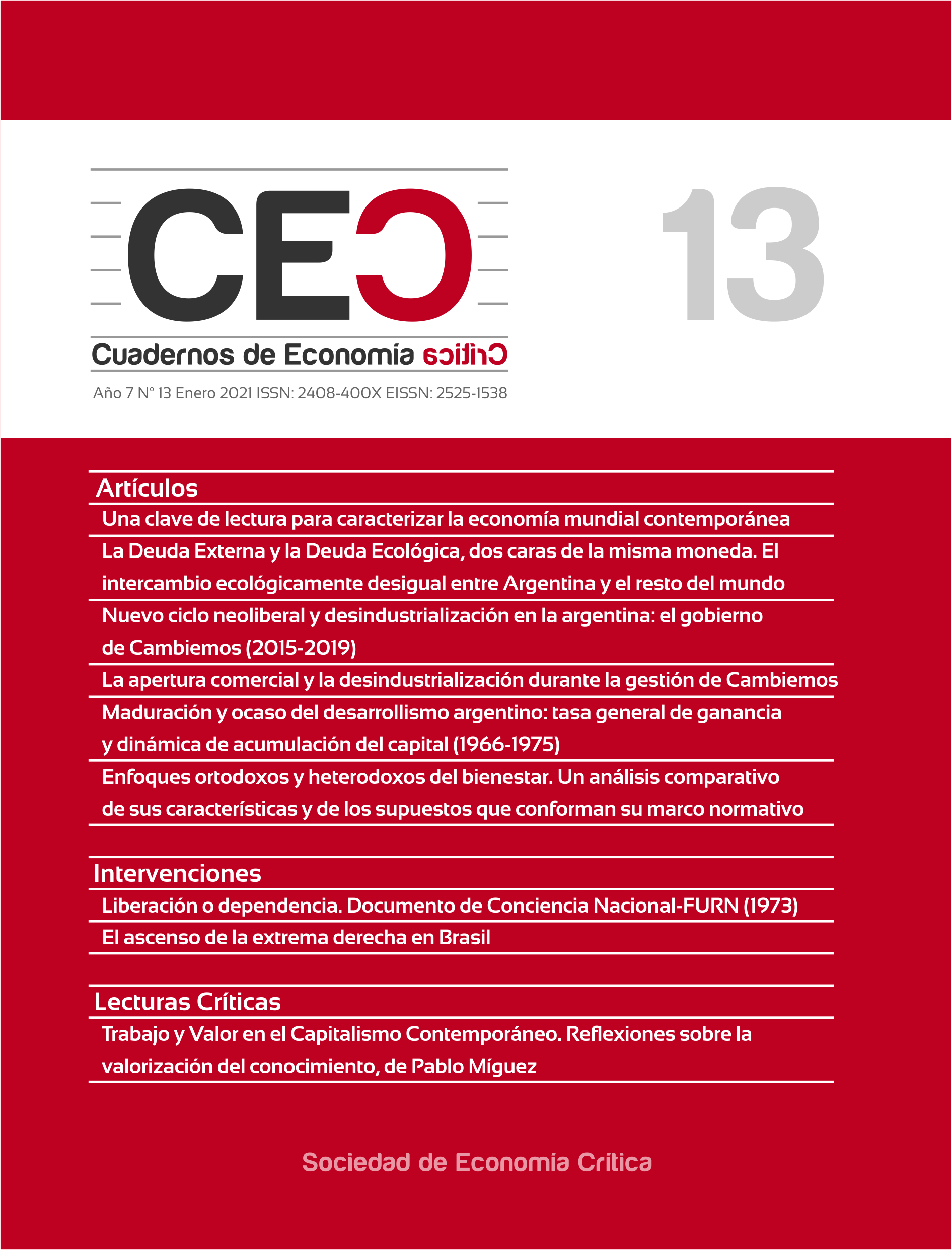
El ascenso de la extrema derecha en Brasil
Keywords:
Política Económica, Gobierno Temer, Austeridad, Gobierno Bolsonaro, NeoliberalismoAbstract
En este texto tratamos el gobierno de Michel Temer y el inicio del gobierno de Bolsonaro, que constituyen no solo un golpe a la frágil democracia burguesa brasileña, el ascenso al poder de un presidente identificado con el pensamiento de la ultraderecha, comprometido no solo a completar la reformas neoliberales en todos los aspectos de la vida económica y social, como promover la destrucción de los avances que Brasil había logrado en el campo de la diversidad, la inclusión, entre otros
Downloads
References
BCB (2019). Banco Central do Brasil. Comunicado n.° 34.005. Recuperado de: https://www.bcb.gov.br/estabilidadefinanceira/exibenormativo?tipo=Comunicado&numero =34005
Emenda Constitucional 95, de 2016. Câmara dos Deputados, Brasil. Recuperado de: https://www2.camara.leg.br/legin/fed/emecon/2016/emendaconstitucional-95-15-dezembro-2016-784029-publicacaooriginal-151558-pl.html
Marques, R. M. (2019). Brasil: direita, volver! Revista da Sociedade Brasileira de Economia Política, (52), 10-39. Recuperado de: http://www.revistasep.org.br/index.php/SEP/issue/view/23
Marques, R. M. y Andrade, P. (2016). Democracia burguesa e dominância do capital portador de juros: apontamentos sobre processos em curso no Brasil. O Olho da História, (24).
Marques, R. M. y Nakatani, P. (2013). El capital fictício y los capitales extranjeros em Brasil. En Estay, J.; Morales, J. y Marques, R. (Coords.). Desarrollo y crisis em el capitalismo (pp. 273-292). Puebla: BUAP; México: UNAM.
Marques, R. M. y Ugino, C. K. (2017). O Brasil é chamado à ordem. Argumentum, 9(3), 8-23.
Published
How to Cite
Issue
Section
License
Copyright (c) 2020 Rosa Maria Marques, Paulo Nakatani

This work is licensed under a Creative Commons Attribution-NonCommercial-NoDerivatives 4.0 International License.
Copyright notice
Authors retain copyright and grant the journal the right to be the first publication of the work as licensed under a Creative Commons Attribution License that allows others to share the work with an acknowledgement of authorship of the work and initial publication in this journal.
Authors may separately enter into additional arrangements for non-exclusive distribution of the version of the work published in the journal (e.g., placing it in an institutional repository or publishing it in a book), with an acknowledgement of initial publication in this journal.
Authors are allowed and encouraged to disseminate their work electronically (e.g. in institutional repositories or on their own website) before and during the submission process, as it may lead to productive exchanges, as well as earlier and higher citation of published work (see The Effect of Open Access).


