
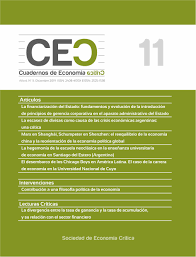
The The disembarkation of the Chicago Boys in Latin America.
The case of the economics degree at the Universidad Nacional de Cuyo.
Abstract
The Faculty of Economic Sciences of the National University of Cuyo was one of the first places in Latin America where an American education program under the Alliance for Progress was applied in the teaching of economics. To this day, a neoliberal economy based on the precepts of the Chicago School is being preached. This article gives an account of the epistemological foundations that underlie the curriculum and shows that its establishment and prevalence were not innocent but the product of a political process of dispute of meaning. For this, a qualitative research was carried out contemplating within the methodological instruments the analysis of documents and the performance of semi-structured interviews to key actors in the process of reformulation of the plan.
Keywords: school of Chicago; neoliberalism; programa Cuyo; Cuyo; epistemological foundations; curriculum.
JEL codes: A22; B41.
Downloads
References
Coria, L. A. (2011). Evolución y contradicciones de la Escuela Austríaca. XLVI Reunión Anual de la Asociación Argentina de Economía Política (AAEP). Facultad de Ciencias Económicas, Universidad Nacional de Cuyo, Argentina.
Crespo, R. F. (2002). Noción y tareas de la economía, su carácter normativo y sus conexiones con la ética. Económica, 48(1-2).
Fernández López, M. (2001). La ciencia económica argentina en el siglo XX. Estudios Económicos, 18(38).
Friedman, M. (1953). La metodología de la economía positiva. Revista de Economía Política, 9(2-3), pp. 355-397.
Gabriele, A. (2012). Epistemología retórica y deconstrucción de lo humano (pp. 101-108). En: Díaz, E. [ed.] El poder y la vida: modulaciones epistemológicas. Buenos Aires: Biblos.
Gómez, R. (2014). Neoliberalismo, fin de la historia y después. CABA: Punto de Encuentro.
Marqués, L. G. (1999). Influencia de la metodología estándar sobre la teoría económica neoclásica (pp. 125-140). En: Scarano, E. y Marqués, G. (comp.) Epistemología de la economía. Buenos Aires: a-Z Editora.
Morresi, S. D. (2010) Apuntes preliminares para un estudio del neoliberalismo en la Argentina (pp. 299-315). En: M. Muraca, E. Andriotti Romanín y T. Groth (comps.) Teoría y práctica política: Argentina y Brasil. Nuevas formas de la dependencia, nuevos caminos para el desarrollo. Los Polvorines: UNGS/Prometeo.
Osorio, F. (2007). Epistemología de las ciencias sociales. Santiago: Universidad de Chile. Recuperado de: http://libros.uchile.cl/269
Sjaastad, L. A. (2011). Programa Cuyo: A Short Story. Universidad de Chicago. Universidad del CEMA. Working Paper Series 448.
Ynoub, Roxana C. (2012) Metodología y hermenéutica (pp. 233-256). En: Díaz, E. [ed.] El poder y la vida: modulaciones epistemológicas. Buenos Aires: Biblos.
DOCUMENTOS
UNCuyo. FCE. Ord. 332002- CS. Plan de estudios de la Licenciatura en Economía (1998).
UNCuyo. FCE. Programa de la cátedra Filosofía (2016).
UNCuyo. FCE. Programa de la cátedra Historia Económica l (2016).
UNCuyo. FCE. Programa de la cátedra Introducción a la Economía l (2016).
UNCuyo. FCE. Programa de la cátedra Metodología Básica de la Investigación (2016).
UNCuyo. FCE. Programa de la cátedra Política Económica Argentina (2016).
ENTREVISTAS
Coria, Luis. Comunicación personal (06/12/2016).
Del Vecchio, Sandra. Comunicación personal (12/12/2016).
Martínez Cinca, Carlos. Comunicación personal (05/12/2016).
Medawar, Aldo. Comunicación personal (21/11/2016)
Published
Versions
- 2021-01-12 (2)
- 2019-12-01 (1)
How to Cite
Issue
Section
License
Copyright (c) 2019 Leandro Velasco Cicchitti

This work is licensed under a Creative Commons Attribution-NonCommercial-NoDerivatives 4.0 International License.
Copyright notice
Authors retain copyright and grant the journal the right to be the first publication of the work as licensed under a Creative Commons Attribution License that allows others to share the work with an acknowledgement of authorship of the work and initial publication in this journal.
Authors may separately enter into additional arrangements for non-exclusive distribution of the version of the work published in the journal (e.g., placing it in an institutional repository or publishing it in a book), with an acknowledgement of initial publication in this journal.
Authors are allowed and encouraged to disseminate their work electronically (e.g. in institutional repositories or on their own website) before and during the submission process, as it may lead to productive exchanges, as well as earlier and higher citation of published work (see The Effect of Open Access).


