
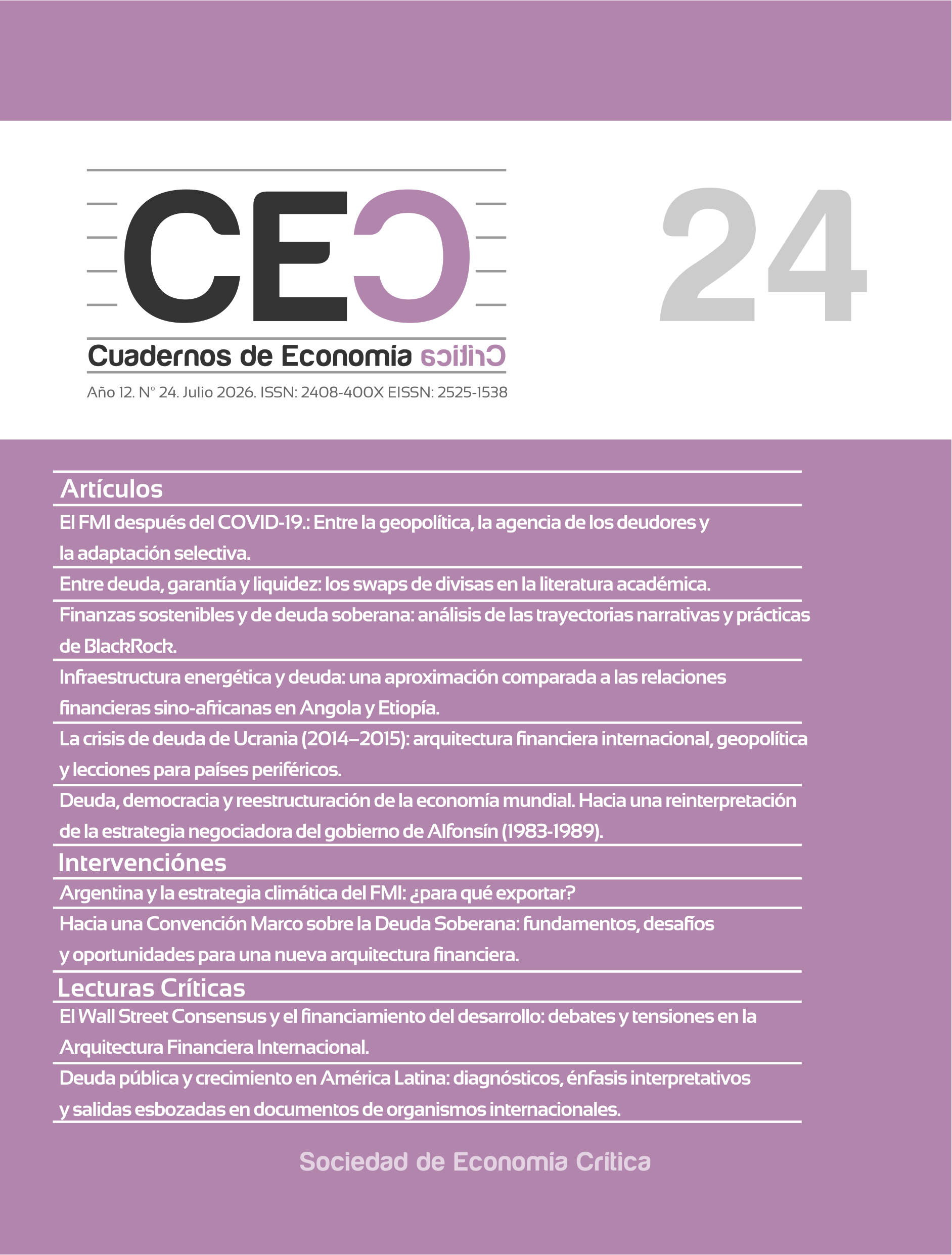
Between Debt, Collateral and Liquidity: Currency Swaps in the Academic Literature
Keywords:
swaps de divisas, diplomacia financiera , arquitectura financiera internacionalAbstract
This article reviews the academic literature on currency swap agreements and examines them as instruments of international liquidity provision, financial backstopping, monetary internationalization, and financial diplomacy. Based on a qualitative bibliographic review, it analyzes their evolution since the 2008 global financial crisis, focusing on three experiences: the Federal Reserve’s liquidity lines, the Chiang Mai Initiative, and bilateral swaps promoted by the People’s Bank of China. The paper argues that swaps cannot be understood as merely technical monetary tools, but as heterogeneous and dynamic devices shaped by asymmetries in the international financial architecture, states’ strategic interests, and domestic politics. The review identifies three analytical dimensions: geoeconomic and financial effects, their role within the global financial safety net, and their political and geopolitical determinants. Finally, it highlights relevant gaps, particularly regarding the relationship between swaps, debt, and state agency.
Downloads
References
Abdullahi, A. M. (2019). China’s bilateral currency swap agreement: Strategic move to foster political and financial hegemony (MPRA Paper No. 109879). Munich Personal RePEc Archive. https://mpra.ub.uni-muenchen.de/109879/
Aizenman, J. (2010). International reserves and swap lines in times of financial distress: Overview and interpretations(ADBI Working Paper No. 192). Asian Development Bank Institute. https://www.adbi.org/working-paper/2010/02/05/3454.intl.reserves.swap.lines.financial.distress/
Aizenman, J., Ito, H. & Pasricha, G. K. (2021). Central bank swap arrangements in the COVID-19 crisis (NBER Working Paper No. 28585). National Bureau of Economic Research. https://doi.org/10.3386/w28585
Aizenman, J., Jinjarak, Y. & Park, D. (2011). International reserves and swap lines: Substitutes or complements? International Review of Economics and Finance, 20(1), 5–18. https://doi.org/10.1016/j.iref.2010.07.002
Aizenman, J. & Pasricha, G. K. (2009). Selective swap arrangements and the global financial crisis: Analysis and interpretation (Working Paper No. 653). University of California, Santa Cruz. https://hdl.handle.net/10419/64502
Almeida Gentile, P. H., Jara Musuruana, L. A. & Tessmer, G. A. (2015). Radiografía del swap Argentina–China(Informes Especiales No. 4). Observatorio Económico Social, Universidad Nacional de Rosario. https://rephip.unr.edu.ar/server/api/core/bitstreams/90e410f0-86ac-43be-bc70-bdb686b9afa6/content
Alonso, J. A. (2011). La gran recesión: respuestas y desafíos. En Crisis económica y nueva gobernanza internacional(pp. 11–30). Real Instituto Elcano.
Armijo, L. E. & Katada, S. N. (2015). Theorizing the financial statecraft of emerging powers. New Political Economy, 20(1), 42–62. https://doi.org/10.1080/13563467.2013.866082
Bahaj, S. & Reis, R. (2018). Central bank swap lines (Bank of England Working Paper No. 741). Bank of England. https://doi.org/10.2139/ssrn.3222673
Bahaj, S. & Reis, R. (2020). Central bank swap lines during the COVID-19 pandemic. Covid Economics, 2(1), 1–12. https://personal.lse.ac.uk/reisr/papers/20-covidcbswaps.pdf
Bahaj, S. & Reis, R. (2021). The working of liquidity lines between central banks. SSRN. https://doi.org/10.2139/ssrn.3760080
Bahaj, S. & Reis, R. (2022a). Central bank swap lines: Evidence on the effects of the lender of last resort. The Review of Economic Studies, 89(4), 1654–1693. https://doi.org/10.1093/restud/rdab074
Bahaj, S. & Reis, R. (2022b). The economics of liquidity lines between central banks. Annual Review of Financial Economics, 14(1), 57–74. https://doi.org/10.1146/annurev-financial-111620-022146
Bayne, N. (2008). Financial diplomacy and the credit crunch: The rise of central banks. Journal of International Affairs, 62(1), 1–16. https://www.jstor.org/stable/24358141
Bayne, N. & Woolcock, S. (2007). What is economic diplomacy? En N. Bayne & S. Woolcock (Eds.), The new economic diplomacy: Decision-making and negotiation in international economic relations (2nd ed., pp. 1–20). Ashgate.
Benguria, F. & Novy, D. (2025). How to grow an invoicing currency: Micro evidence from Argentina (CESifo Working Paper No. 11964). CESifo. http://dx.doi.org/10.2139/ssrn.5336048
Brandão Monte, H. (2021). Os acordos de swap (BSAs) na estratégia econômica chinesa. Revista Îandé – Ciências e Humanidades, 5(2), 39–63. https://doi.org/10.36942/iande.v5i2.111
Brenta, N. & Larralde, J. (2018). La internacionalización del renminbi y los acuerdos de intercambio de monedas entre Argentina y China, 2009–2018. Ciclos, 25(51), 55–84.
Broz, J. L. & Zhang, Z. (2018). Explaining foreign interest in China’s global economic leadership: Bilateral currency swap agreements [Ponencia]. Political Economy of International Organization Conference (PEIO). https://www.peio.me/wp-content/uploads/2019/01/PEIO12_paper_16.pdf
Carrera, J. (2009). El G20, la crisis y el rediseño de la Arquitectura Financiera Internacional. Ensayos Económicos, 53/54, 217-244. Banco Central de la República Argentina. https://www.bcra.gob.ar/archivos/Pdfs/investigaciones/53-54-10-carrera.pdf
Castiglioni, L. (2026). Una propuesta de periodización de la Arquitectura Financiera Internacional, 1944-2025. Ciclos en la historia, la economía y la sociedad, 65, 27-54. https://doi.org/10.56503/CICLOS/Nro.65(2025)/3545
Cefaly, N. (2022). El papel del Banco Central de la República Argentina en la ejecución de la política exterior en la década 2008–2018 [Tesis de Maestría]. FLACSO Argentina.
Chesnais, F. (2008). El fin de un ciclo. Laberinto, (26–27), 69–86.
Chiacchiera, M. A. (2017). La estrategia de construcción de poder de China a través de los acuerdos swaps de divisas: El caso de Argentina y Brasil (Tesina de grado). Universidad Nacional de Rosario.
Chin, G. T. & Gallagher, K. P. (2025). China and the global economic order. Cambridge University Press. https://doi.org/10.1017/9781009509053
Destais, C. (2014). Central bank currency swaps and the international monetary system (CEPII Policy Brief No. 2014-05). CEPII. https://www.cepii.fr/pdf_pub/pb/2014/pb2014-05.pdf
Eichengreen, B. (2009). The financial crisis and global policy reforms [Ponencia]. Federal Reserve Bank of San Francisco Conference. https://eml.berkeley.edu/~eichengr/finan_cri0sis_glob_pol_10-09.pdf
Fernández Alonso, J. (2022). La economía política de swaps de monedas. Ola Financiera, 15(42), 38–82. https://doi.org/10.22201/fe.18701442e.2022.42.82584
García-Escudero, E. E. & Sánchez Pérez, E. J. (2020). Los swaps de divisas entre bancos centrales (Documentos Ocasionales No. 2025). Banco de España. https://www.bde.es/f/webbde/SES/Secciones/Publicaciones/PublicacionesSeriadas/DocumentosOcasionales/20/Fich/do2025.pdf
García-Herrero, A. & Xia, L. (2015). RMB bilateral swap agreements: How China chooses its partners? Asia-Pacific Journal of Accounting & Economics, 22(4), 368–383. https://doi.org/10.1080/16081625.2014.960059
Goda, T., Mühlich, L. & Fritz, B. (2025). You are worth that to me – Uncovering the hierarchy of central bank currency swap scale [Ponencia]. FMM Conference. https://www.imk-boeckler.de/data/downloads/OEA/Veranstaltungen/2025/v_2025_10_24_goda.pdf
Horn, S., Parks, B. C., Reinhart, C. M. & Trebesch, C. (2023). China as an international lender of last resort (World Bank Policy Research Working Paper No. 10380). World Bank. https://documents1.worldbank.org/curated/en/099450403272313885/pdf/IDU046bbbd8d06cc0045a708397004cbf4d2118e.pdf
Hurtado Briceño, A. J. & Zerpa de Hurtado, S. (2020). China-Mercosur: Impacto de los acuerdos swaps. Cuadernos del CENDES, 37(104), 83–103.
Jara, A., Moreno, R. & Tovar, C. E. (2009). The global crisis and Latin America: Financial impact and policy responses. BIS Quarterly Review, June, 53-68. https://www.bis.org/publ/qtrpdf/r_qt0906f.pdf
Jiang, L., Liu, S. & Zhang, G. (2023). The effect of bilateral currency swap agreements on foreign capital inflows. Southern Economic Journal, 90(2), 444–473. https://doi.org/10.1002/soej.12652
Joudar, F. & Dinar, B. (2022). Toward understanding financial diplomacy: The case of Morocco. International Journal of Accounting, Finance, Auditing, Management and Economics, 3(3-1), 109–123. https://doi.org/10.5281/zenodo.6582481
Kentikelenis, A. E., Stubbs, T. H. & King, L. P. (2016). IMF conditionality and development policy space, 1985–2014. Review of International Political Economy, 23(4), 543–582. https://doi.org/10.1080/09692290.2016.1174953
Koosakul, J. & Miksjuk, A. (2024). Central banks casting a global financial safety net (IMF Working Paper No. 24/88). IMF. https://doi.org/10.5089/9798024105091.001
Liao, S. & McDowell, D. (2015). Redback rising. International Studies Quarterly, 59(3), 401–422. https://doi.org/10.1111/isqu.12161
Liao, S. & McDowell, D. (2016). No reservations. International Studies Quarterly, 60(2), 272–293. https://doi.org/10.1093/isq/sqv020
Li, L., Mei, D. & Li, R. (2020). The impact of RMB swap agreements on foreign exchange reserve demand. Applied Economics, 52(59), 6453–6467. https://doi.org/10.1080/00036846.2020.1796916
Li, S., Sahasrabuddhe, A. & Wingo, S. (2024). The limits of financial statecraft [Ponencia]. PEIO Conference. https://doi.org/10.2139/ssrn.4916211
Lin, Z., Zhan, W. & Cheung, Y.-W. (2016). China’s bilateral currency swap lines. China & World Economy, 24(6), 19–42. https://doi.org/10.1111/cwe.12179
Liu, J., Liu, T., Liu, Y. & Lu, D. (2025). The impact of central bank swap lines on international currency competition(Working paper). SSRN. https://doi.org/10.2139/ssrn.4908530
Lopes Marra de Sousa, A. T. & Daldegan, W. (2020). A China e os acordos de swap cambial com Argentina, Brasil, Chile e Suriname. Revista Tempo do Mundo, (24), 251–282. https://doi.org/10.38116/rtm24art9
Machinea, J. L. (2009). La crisis financiera internacional. Revista CEPAL, (97), 33–56. https://hdl.handle.net/11362/37423
McDowell, D. (2019). The (ineffective) financial statecraft of China’s bilateral swap agreements. Development and Change, 50(1), 122–143. https://doi.org/10.1111/dech.12474
McDowell, D. & Steinberg, D. A. (2017). Systemic strengths, domestic deficiencies. Journal of Contemporary China. https://doi.org/10.1080/10670564.2017.1337292
Mühlich, L. & Goda, T. (2024). Rethinking the role of central bank currency swaps [Policy brief]. Global Solutions Initiative. https://www.global-solutions-initiative.org/publication/rethinking-the-role-of-central-bank-currency-swaps-to-strengthen-the-global-financial-safety-net-for-developing-countries-new-empirical-evidence/
Park, H. S. (2016). China’s RMB internationalization strategy (M-RCBG Working Paper No. 63). Harvard Kennedy School. https://www.hks.harvard.edu/sites/default/files/centers/mrcbg/files/park_final.pdf
Perks, M., Rao, Y., Shin, J. & Tokuoka, K. (2021). Evolution of bilateral swap lines. IMF Working Paper (2021/210). IMF. https://doi.org/10.5089/9781513590134.001
Reis, R. (2019). A solution to sudden stops. Finance & Development, 56(2), 42–43. https://www.imf.org/external/pubs/ft/fandd/2019/06/pdf/fd0619.pdf
Salama, P. (2010). Una crisis financiera estructural. Íconos, (36), 19–28. https://doi.org/10.17141/iconos.36.2010.401
Song, K. & Xia, L. (2020). Bilateral swap agreement and renminbi settlement. Economic and Political Studies, 8(3), 355–373. https://doi.org/10.1080/20954816.2020.1780818
Steinberg, D. (2024). Do currency swaps help China win friends and influence people? Wilson Center. https://www.wilsoncenter.org/sites/default/files/media/uploads/documents/2024-WCF_Steinberg.pdf
Strange, S. (1975). What is economic power, and who has it? International Journal, 30(2), 207-224. https://doi.org/10.1177/002070207503000202
Tello-Casas, P. (2024). El papel de China como acreedor financiero internacional (Documentos Ocasionales No. 2435). Banco de España. https://doi.org/10.53479/38299
Tobías, M. & Hordern, A. (2025, 14 de abril). Bessent espera que Argentina pueda pagar la línea swap con China. Bloomberg. https://www.bloomberg.com/news/articles/2025-04-14/bessent-espera-que-argentina-pueda-pagar-la-linea-swap-con-china-m9hkdkgx
Weder di Mauro, B. & Zettelmeyer, J. (2017). The new global financial safety net. CIGI Essays in International Finance, 4. https://ssrn.com/abstract=2946452
Xinhua (16 de febrero de 2024). China’s central bank signs 40 currency swap agreements with foreign counterparts. The State Council of the People’s Republic of China. https://english.www.gov.cn/news/202402/16/content_WS65cef3efc6d0868f4e8e40d3.html
Yelery, A. (2016). China’s bilateral currency swap agreements. China Report, 52(2), 138–150. https://doi.org/10.1177/0009445515627210
Zhang, F., Yu, M., Yu, J., & Jin, Y. (2017). The effect of RMB internationalization on the Belt and Road Initiative. Emerging Markets Finance and Trade, 53(12), 2845–2857. https://doi.org/10.1080/1540496X.2017.1382346
Published
How to Cite
Issue
Section
License
Copyright (c) 2026 Rocío Ceballos

This work is licensed under a Creative Commons Attribution-NonCommercial-NoDerivatives 4.0 International License.
Copyright notice
Authors retain copyright and grant the journal the right to be the first publication of the work as licensed under a Creative Commons Attribution License that allows others to share the work with an acknowledgement of authorship of the work and initial publication in this journal.
Authors may separately enter into additional arrangements for non-exclusive distribution of the version of the work published in the journal (e.g., placing it in an institutional repository or publishing it in a book), with an acknowledgement of initial publication in this journal.
Authors are allowed and encouraged to disseminate their work electronically (e.g. in institutional repositories or on their own website) before and during the submission process, as it may lead to productive exchanges, as well as earlier and higher citation of published work (see The Effect of Open Access).


