
Transformações do financiamento internacional ao desenvolvimento:
debates e tensões a partir da Economia Política Internacional na pós-crise global de 2008
Palavras-chave:
economia política internacional, financiamento ao desenvolvimento, financeirização, arquitetura financeira internacional, sustentabilidade.Resumo
A crise financeira global de 2008 constitui um ponto de inflexão no financiamento internacional ao desenvolvimento, associado a mudanças na Arquitetura Financeira Internacional (AFI) e nos mecanismos de provisão de recursos para os países em desenvolvimento. A partir da perspectiva da Economia Política Internacional (EPI), este artigo analisa as transformações nos instrumentos, atores e instituições do financiamento ao desenvolvimento no período posterior à crise. O trabalho se insere nos debates do campo sobre a relação entre poder, mercados e instituições (Cohen, 2008; 2022) e nas contribuições que examinam essas dinâmicas a partir da América Latina (Tussie, 2015). Com base nesse marco analítico, examina-se a expansão da financeirização do desenvolvimento e a reconfiguração do papel das instituições financeiras internacionais, particularmente a partir do conceito de Wall Street Consensus (Gabor, 2021). Além disso, discutem-se as implicações das agendas internacionais relacionadas à sustentabilidade, à transição energética e às mudanças climáticas (Cadman e Sarker, 2022), bem como as tensões associadas aos padrões extrativistas de inserção internacional na América Latina (Acosta, 2020). O artigo sustenta que essas transformações se articulam com as estruturas existentes da AFI e tendem a reproduzir assimetrias no sistema internacional.
Downloads
Referências
Chin, G. & Gallagher, K. (2019). Coordinated Credit Spaces: The Globalization of Chinese Development Finance. Development and Change, 50(1), 245-274. https://doi.org/10.1111/dech.12470
Cohen, B. J. (2008). International political economy: An intellectual history. Princeton University Press.
Cohen, B. J. (2022). Rethinking international political economy. Edward Elgar Publishing.
Gabor, D. (2021). The Wall Street consensus. Development and Change, 52(3), 429-459. https://doi.org/10.1111/dech.12645
Molinari, A. & Patrucchi L. (2020). Rompiendo el molde: logros y desafíos de los nuevos bancos de desarrollo. Revista Ciclos en la Historia, la Economía y la Sociedad, (54), 131-155. https://ri.conicet.gov.ar/handle/11336/145663
Molinari, A. & Patrucchi, L. (2022). Limitantes financieros y mandato contracíclico: manifestaciones recientes en los bancos multilaterales de desarrollo. Revista Ciclos en la Historia, la Economía y la Sociedad, (58), 193-220. https://doi.org/10.56503/CICLOS/Nro.58(2022)pp.193-220
Rey, H. (2015). ‘Dilemma not Trilemma: The Global Financial Cycle and Monetary Policy Independence’. NBER Working Paper (21162). National Bureau of Economic Research.
Tussie, D. (2015). Relaciones Internacionales y Economía Política Internacional: notas para el debate. Relaciones Internacionales, (48). 155-175.
Wang, H. (2017). New Multilateral Development Banks: Opportunities and Challenges for Global Governance. Global Policy, 8(1), 113-118. https://onlinelibrary.wiley.com/doi/epdf/10.1111/1758-5899.12396
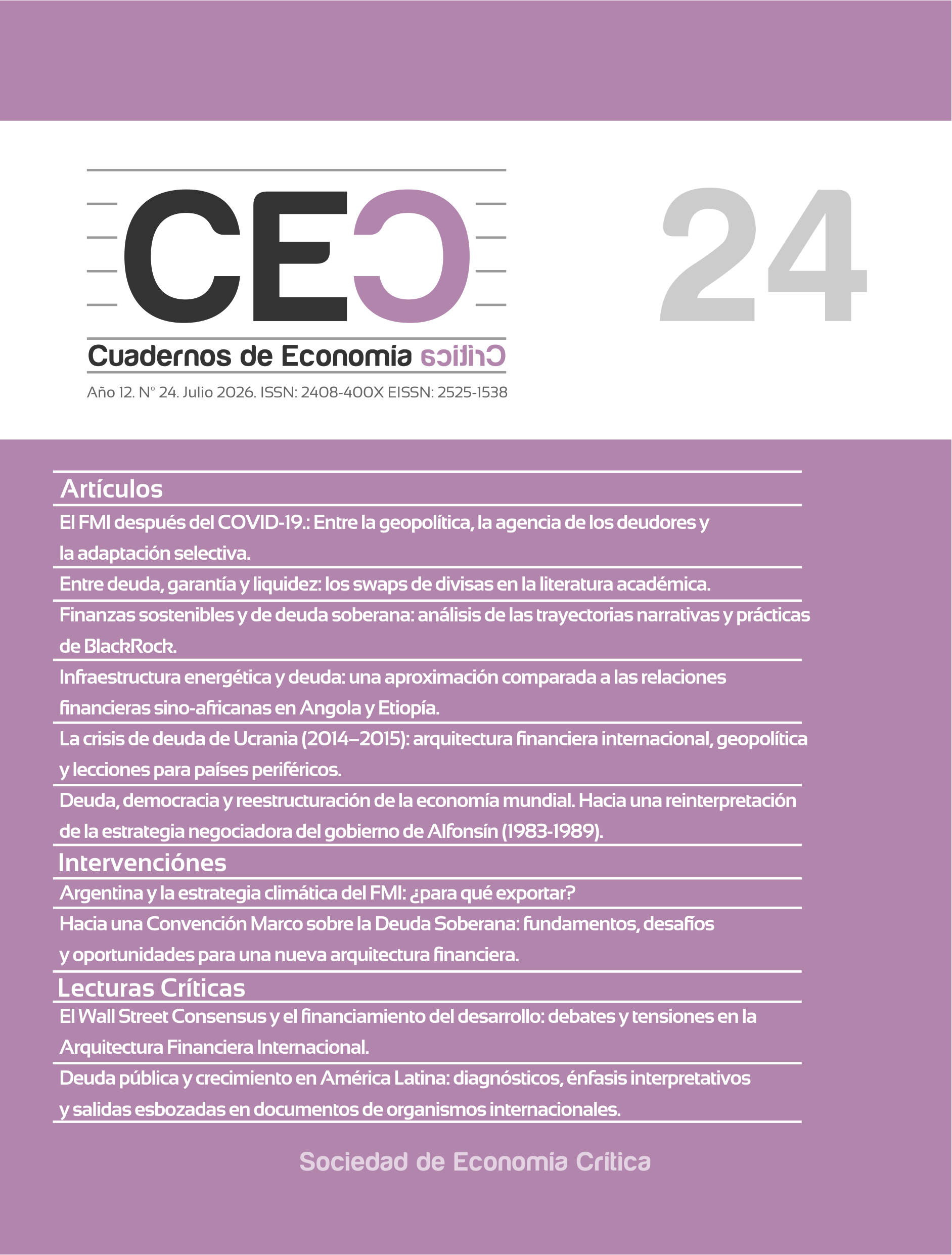
Publicado
Como Citar
Edição
Seção
Licença
Copyright (c) 2026 Irene Sacco

Este trabalho está licenciado sob uma licença Creative Commons Attribution-NonCommercial-NoDerivatives 4.0 International License.
Aviso de direitos autorais
Os autores retêm os direitos autorais e concedem à revista o direito de ser a primeira publicação do trabalho, conforme licenciado sob uma Licença de Atribuição Creative Commons que permite que outros compartilhem o trabalho com um reconhecimento da autoria do trabalho e da publicação inicial nesta revista.
Os autores podem, separadamente, entrar em acordos adicionais para a distribuição não exclusiva da versão do trabalho publicada na revista (por exemplo, colocando-a em um repositório institucional ou publicando-a em um livro), com um reconhecimento da publicação inicial nesta revista.
Os autores têm permissão e são incentivados a disseminar seu trabalho eletronicamente (por exemplo, em repositórios institucionais ou em seu próprio site) antes e durante o processo de submissão, pois isso pode levar a trocas produtivas, bem como a uma citação mais precoce e mais alta do trabalho publicado (consulte O efeito do acesso aberto) (em inglés).


